


Reviews

Written in Music- Museum of Human Happiness

Het zal niemand verbazen dat een geroutineerde muzikant als Edward Ka-Spel het liefste effectief te werk gaat. Uiteraard met de nodige ruimte voor het experiment en die gretigheid om steeds weer die vernieuwing op te zoeken. Maar als je dan genoodzaakt bent om afzonderlijk van elkaar aan een plaat te werken is dat wel zwaar balen. In die situatie verkeren de oudgedienden van The Legendary Pink Dots tijdens de viering van hun veertigjarige bestaan. Corona maakt een einde aan het feestje, maar gelukkig niet aan het succesverhaal. The Museum Of Human Happiness heeft die ouderwetse vorm, en is zelfs stukken urgenter dan de meer dan prima voorganger Angel in the Detail.

Oudheden en obscuriteit. Artistiek en vernieuwend. This is The Museum brengt je terug naar de zomer van 1980. De nasleep van de rellen bij de bekroning van koningin Beatrix, de oplopende spanningen bij het Margaret Thatcher regime. Een hoog werkeloosheidsgehalte en het idealisme van punk en postpunk. Twee werelden treffen elkaar, botsen en brengen een oerknal voort. The Legendary Pink Dots is een feit. Die tienerangst domineert hedendaags weer, en hebben we dan oude vergeten helden nodig om die wanhoop te reflecteren? Ja, blijkbaar wel.

The Legendary Pink Dots, ze zijn weer terug, maar dan nu ook echt. Human Happiness in een No Fun maatschappij. Edward Ka-Spel is nog steeds die jonge idealistische strijder, gevangen in een op leeftijd zijnde getekend lichaam, opgesloten in een lockdown gemeenschap. Het getergde geweten, ontwakend als een bloedzuigende vampier, zichzelf voedende met egocentrisme en misplaatste teleurstellingen. De instrumentatie bouwt zijn eigen netwerk, met verstrikte spinnenwebdraden, kerkelijke geloof aanvechtende orgelpartijen en de roep om de versmorende chaos te controleren. Verlaten straten, isolement en eenzaamheid als A Stretch Beyond basisbegrippen. Een vervreemde buitenstaander die het verval objectief als een onwerkelijk leefklimaat kanaliseert.

Behoed je voor de omgeving, There Be Monsters in dit verhalende sprookjesboek, waarbij de bevlekte kanttekeningen een onoverzichtelijke warboel vormen. Edward Ka-Spel is net zo onbetrouwbaar als die bespiedende omgeving. Muzikaal ongemak en onzichtbare valkuilen laten je in die onvatbare wereld van dit onberekenbare genie verdwalen. Als je zijn steun opzoekt, bemerk je dat die helpende handdruk je allang verlaten heeft. Vanaf hier sta je er alleen voor. De toereikende gids gooit je de donkere diepte in. En daar draait het bij het onberekende This is The Museum om. De opgelegde The Legendary Pink Dots breuk speelt met die overlevingsdrang. Samen de ontbrekende puzzelstukken plaatsen, met beperkte middelen binnen handbereik.

De vanzelfsprekende vastigheid spant met het verliezen van de gecreëerde werkelijkheid samen. Tripping On My Nightmares, realistisch slaapwandelen in opvullende leegte en gedirigeerde wanorde. Coronation Street waarheden en internet Tel Sell Fake News. Verkoop je oprechtheid aan de wantrouwige internetsurfer, geef hem een sprankje aan plastic hoop cadeau. De Brexit in het conservatieve naar vergaande tijden verlangde Cruel Brittania, waardoorheen brokken aan historische folklore uiteenspatten. Er wordt weer ouderwets, totdat de noise zijn ontvlambare kookpunt bereikt, aan de knoppen gedraaid. Barricades met torenhoge lawaaierige ijzerplaten opgebouwd, gitaren grondig gesloopt, verloren pianotoetsen zonen binnengehaald en een anarchistisch leger aan opdringerige tribal Electric Body Music beats losgelaten. Heerlijk verdwalen in de neurotisch grommende bas van Postcards From Home en de psychedelische 1969 The Girl Who Got There First roes.

We leven in een futuristische 1984, de 2.0 variant, waar Big Brother een onmisbare vriend is, en we voorgeprogrammeerd de eisen van de wereldleiders opvolgen. Die afzijdige losgekoppelde werkwijze heeft The Legendary Pink Dots het gewenste resultaat opgeleverd. Er worden luchtkastelen vernietigd, en met de puinresten verbindende wankele bruggen aangelegd. Het geluid van The Museum Of Human Happiness is net zo nostalgisch als 2022, alleen beseffen we dat nog niet helemaal. The Museum Of Human Happiness is de plaat die Edward Ka-Spel veertig jaar geleden nog niet durfde te maken, zelfs niet hoopte te maken.

Het album The Museum of Human Happiness van The Legendary Pink Dots is uitgebracht door Metropolis op 18 maart 2022.

source: writteninmusic.com
Geschreven door: Leon Pouwels
March 16, 2022

English (via Google Translate)
It will come as no surprise that a seasoned musician like Edward Ka-Spel prefers to work effectively. Of course with the necessary space for experimentation and that eagerness to keep looking for that innovation. But if you’re forced to work on a record separately from each other, that’s a real bummer. That’s the situation the veterans of The Legendary Pink Dots find themselves in during the celebration of their 40th anniversary. Corona puts an end to the party, but luckily not to the success story. The Museum Of Human Happiness has that old-fashioned shape, and is even much more urgent than its more than fine predecessor Angel in the Detail.

Antiquities and obscurity. Artistic and innovative. This is The Museum takes you back to the summer of 1980. The aftermath of the riots at the crowning of Queen Beatrix, the rising tensions within the Margaret Thatcher regime. A high level of unemployment and the idealism of punk and post-punk. Two worlds collide, collide and produce a big bang. The Legendary Pink Dots is a fact. That teenage fear dominates today, so do we need old forgotten heroes to reflect that desperation? Yes, apparently it is.

The Legendary Pink Dots, they’re back, but now for real. Human Happiness in a No Fun Society. Edward Ka-Spel is still that young idealistic warrior, trapped in an aging scarred body, locked in a lockdown community. The provoked conscience, awakening like a blood-sucking vampire, feeding itself on self-centeredness and misguided disappointments. The instrumentation builds its own network, with entangled cobwebs, ecclesiastical faith-challenging organ parts and the call to control the choking chaos. Deserted Streets, Isolation and Loneliness as A Stretch Beyond Basic Concepts. An alienated outsider who objectively channels decay as an unreal living environment.

Protect yourself from the environment, There Be Monsters in this storytelling fairy tale book, where the stained notes form a cluttered mess. Edward Ka-Spell is as unreliable as that spying environment. Musical discomfort and invisible pitfalls let you get lost in the elusive world of this unpredictable genius. If you seek his support, you will find that helping handshake has long since left you. From here on you are on your own. The adequate guide throws you into the dark depths. And that’s what the unpredictable This is The Museum is all about. The imposed The Legendary Pink Dots break plays with that urge to survive. Place the missing puzzle pieces together, with limited resources at your fingertips.

The self-evident steadfastness conspires with the loss of the created reality. Tripping On My Nightmares, realistic sleepwalking in filling emptiness and directed disorder. Coronation Street Truths And Internet Tel Sell Fake News. Sell ​​your sincerity to the suspicious internet surfer, give him a spark of plastic heap. The Brexit in the conservative era longed for Cruel Brittania, through which chunks of historical folklore shattered. The old-fashioned way, until the noise reaches its flammable boiling point, is again turned on the knobs. Built up barricades with towering noisy iron plates, guitars thoroughly demolished, lost piano keys brought in sons and unleashed an anarchic army of intrusive tribal Electric Body Music beats. Get lost in the neurotic growling bass of Postcards From Home and the psychedelic 1969 The Girl Who Got There First intoxication.

We live in a futuristic 1984, the 2.0 variant, where Big Brother is an indispensable friend, and we follow the pre-programmed demands of the world leaders. This aloof, disconnected working method has yielded the desired result for The Legendary Pink Dots. Castles in the air are destroyed, and shaky bridges connecting with the rubble are built. The sound of The Museum Of Human Happiness is just as nostalgic as 2022, only we don’t fully realize it yet. The Museum Of Human Happiness is the record that Edward Ka-Spel did not dare to make, nor even hoped to make forty years ago.

The Legendary Pink Dots’ album The Museum of Human Happiness is released by Metropolis on March 18, 2022.

ReView: Edward Ka-Spel – Prints of Darkness

Edward Ka-Spel
Album: Prints of Darkness
Category: Experimental / Electronic / Rock
Label: Self-released
Release Date: 2021-03-05

Across four decades fronting The Legendary Pink Dots, as a solo artist, and numerous projects that have encompassed virtually all forms of underground experimental music, one should know what to expect from an Edward Ka-Spel album. With the global pandemic serving as a backdrop of lyrical and tonal inspiration, Prints of Darkness certainly meets these expectations as an almost orchestrally crafted blend of psychedelic space rock, coldly ambient electronic textures, and a small helping of industrial noise that thankfully does not intrude on the melodic songwriting. Not that Ka-Spel needs such abrasive elements as even in his most tuneful and inviting moments, he manages to instill a sense of urgency, the music all the while taking some occasionally radical turns; of course, this may not be surprising given the compound nature of certain tracks.

For example, the opener begins with the whimsical, almost vaudevillian “Destiny’s Casino,” Ka-Spel’s voice emotive and hypnotic, transitioning smoothly into the pensive serenity of “Afternoon Delight,” in which an almost dreamy ‘60s pop vibe underscores the gritty whispers of “Everything is perfect.” Similarly, the rhythmic immediacy of the synth arpeggios in “All at Sea” is certainly engaging, Ka-Spel’s voice sampled into a bubbly and bouncy counterpoint that is somehow evocative of David Bowie during his ‘90s flirtations with contemporary electronica and industrial, the track seamlessly entering the piano nocturne of “Magic Finger,” the pitch-manipulated repetitions of “Eenie-meenie-miney-moe, who will be the first to go” making for one of the record’s truly nightmarish moments, lovely yet menacing in its simplicity.

Certain moments on Prints of Darkness seem atypically topical for Ka-Spel, with the almost exhausted and exasperated tone of his voice on “Not Going Out” befitting the title, as if to convey the disappointment and despair of isolation, set paradoxically to a somewhat jaunty concoction of acoustic guitar, piano, flutes, and rolling bass-laden electronics. The same can be said of the pseudo sociopolitical paranoia of the lyrics in “The Cruelest Conspiracy / Nanny State,” while the ascending phrases of “Spiky Spheres” set to vibrant synths and distorted lead passages act almost as a mantra. But some of the album’s best material comes from standalone tracks like “Mood For Today” with its lovely ambience and energetic IDM beat somehow reminiscent of the adventurous sounds of early Peter Gabriel, or the groovy funk-laden guitars and bass progressions amid almost tribal Brit-hop beats akin to a Guy Ritchie movie on “How to Suck Seed,” the staccato keyboard/sampled guitar solo delightful in its joviality.

Even as we end in a somewhat processional manner with lines like “Don’t blame me” and “It’s your fault” echoing into the sonic miasma, the impression Prints of Darkness leaves is not solely one of sullen defeat. Just as his style blends seemingly disparate genres, so too are Ka-Spel’s lyrical moods and expressions – joy, sorrow, confusion, rage, and all points in between are presented in his usual artful manner, making for a listening experience that can be at times uneven, but again, nothing we’ve not learned to admire in Edward Ka-Spel’s work thus far.

Track list:
Destiny’s Casino / Afternoon Delight
This Is the Place
Mood For Today
The Cruelest Conspiracy / Nanny State
Not Going Out
All at Sea / Magic Finger
How to Suck Seed
Sea Dog
Spiky Spheres
The Persuader / The Hardest Word

by Ilker Yücel (Ilker81x)
Source: Regenmag.com

Angel In The Detail (mmhradio.co.uk)

Album Review: The Legendary Pink Dots – Angel In The Detail

By JohnESmoke | jonathan watkiss Reviews

The always clever and mind expanding Legendary Pink Dots return once more with new album ‘Angel In The Detail’ and it is a blinder.The Legendary Pink Dots exist outside of the defined mainstream and are a band treasured by many, though perhaps nowhere near as many as they deserve. It is therefore my job as reviewer to try and convince the uninitiated that they should give this album a thoroughly good spin. So how shall I hook you dear reader? Well, imagine a trippy and eclectic collision between Bowie at his most experimental, Pink Floyd at their most atmospheric and throw in oodles of prog and electronica, are you intrigued yet?
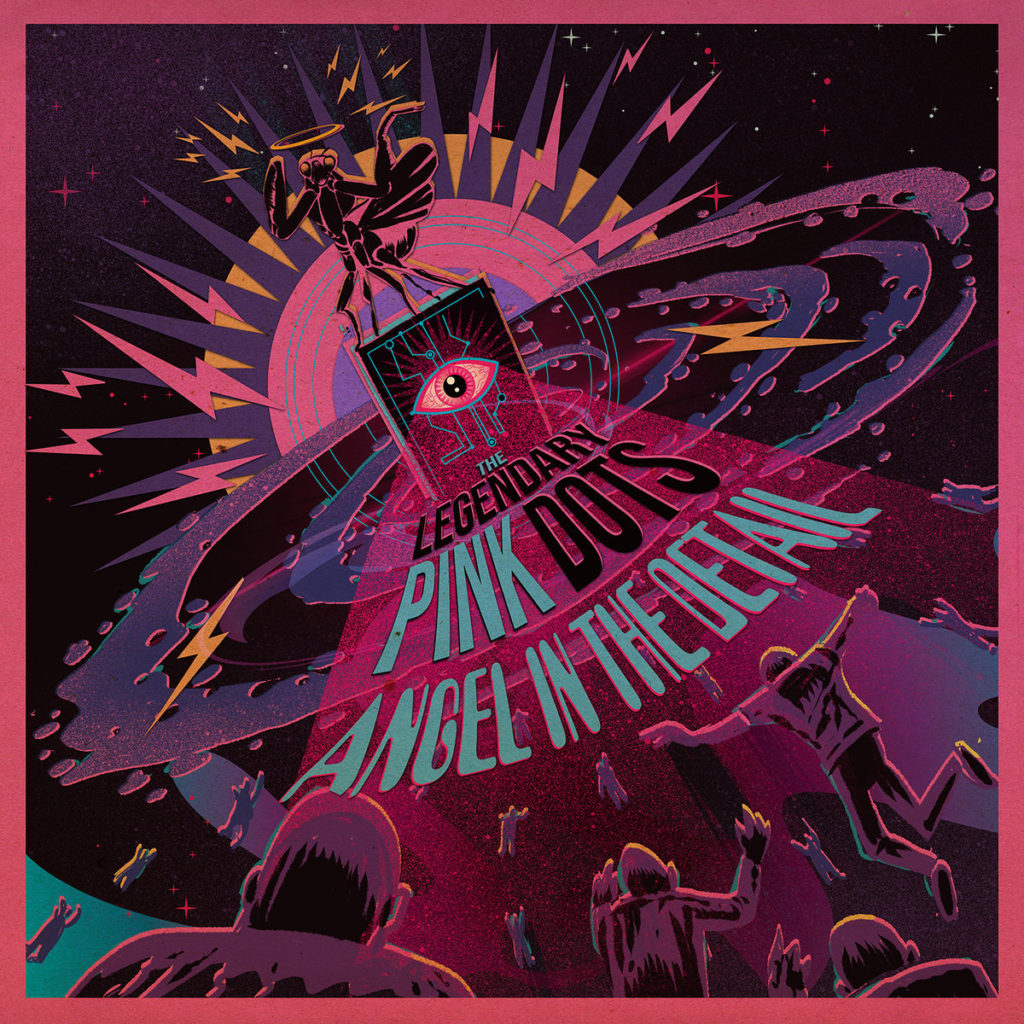
For those of you already acquainted with the Dots to some degree, I’ll bring you up to speed. This album brings their release tally to more than 40 albums in a four decade career. A daunting prospect for a new listener to wrap their head around, but don’t be off put, start here! Chief Dots Edward Ka-Spel (vocals, keyboards, songwriter) and Phil Knight [aka The Silverman] (keyboards, electronics), are joined by guitarist Erik Drost for ‘Angel In The Detail’, the band’s follow-up to 2016’s ‘Pages Of Aquarius’.

Now, ‘Angel In The Detail’ is unmistakable as a Dots album, but it is also clearly a very strong entry in their discography. It is surreal, quirky, dense and whimsical, funky and complex and charmingly enjoyable. This is an album that feels alive and full of weird wonder. It starts in an upbeat manner with ‘Happy Birthday Mr President’, hypnotic rhythms and pulsing bass setting the scene for Ka-Spel’s unique voice and surreal poetic lyrics. ‘Double Double’ drifts hazily in comparison, bubbling synths and a touch of guitar, and a chorus that has more than a hint of magic to it. A funky guitar riff introduces ‘Junkyard’, a quirky and poppy song with darkly witty lyrics belying the lighter musical palette. ‘Itchycoo Shark/Isle Of Sighs’ is a two parter with the first being a somber lament to the digital age. Soundscapes bridge the gap into the second part, a brooding and delicious minor key piece. We are not left morose for long however, as ‘Neon Calculators’ feels sprightly and has an urgency to it. Next is another double bill, ‘My Land/Parallels’, the first part of which is surreal collage of bleeps and squelches that is both jarring and tranquil at the same time, while ‘Parallels’ is a slow burner filled with echoes of an ominous future with perhaps a glimmer of hope also. Melodically it is one of the more haunting numbers on the album. Following the pattern of up tempo/brooding, ‘Maid To Measure’ is another kooky psychedelic pop song that sprinkles light on its dark predecessor while lyrics flirt with future sex. Bucking the trend, ‘Mantis’ does not slip back into somber mood and carries itself with a swaying rhythm and crystalline synths. ‘Penultimate track ‘The Photographer’ is a slightly sinister piece of musical drama wit finely crafted bombast, the chorus soaring to heights along with the best of the Dots. And then we reach the conclusion, the eleven minute epic that is ‘Red Flag’, perhaps also the master stroke of the album as it visits countless sonic terrains while somehow making it sound cohesive. Taking in rolling percussion, heavenly choirs, sublime guitar, luscious pads and more besides, it really is a thing of beauty.

I have tried not to dwell too much on the fact that this is the latest in a long line of albums from a band 40 years into their career, as this is such a strong album that it does not need the weight of history to back it up. The production is flawless with everything having its space, the songs are finely crafted and full of subtleties and the lyrics are as strangely poetic as ever. I urge anyone open to wonderfully weird music to give this a go.

Angel In The Detail (I Die: You Die)

THE LEGENDARY PINK DOTS, “ANGEL IN THE DETAIL”

Posted by Bruce | Aug 27, 2019 | Reviews | 0

The Legendary Pink Dots
Angel In The Detail
Metropolis Records

There are plenty of cliches about long-established bands being akin to a well-worn pair of gloves or boots as they age. Comfortable, familiar, they’ve aged in harmony with those who enjoy them. It isn’t just their age which separates The Legendary Pink Dots from such analogies, though they have recently passed the 40 year mark. Instead, I find LPD at this stage to be akin to an impossibly heavy wooden trunk in an attic. No one who lives in the house remembers when or how it got there, it smells of bizarre spices and perfumes which are no longer manufactured, and every time its creaking lid is opened some new but always inexplicable object is found nestled within.

Angel In The Detail is the first proper LP by the Dots since 2016’s Pages Of Aquarius, a veritable eon of a wait by the band’s impossibly voluminous standards (though it’s of course afforded them the opportunity to release something in the area of a dozen live, archival, and jam session records). The result is a lengthy and considered work which feels in keeping with the last decade or so of the band’s history, but somewhat dials back the saturnine and morose mood of the last few records, and even calls back to their quirkiest beginnings.

The instrumental scope of Angel is relatively pared down, with few tracks going into full-bore space-psych excess, but each track has its own distinct (if often minimalist) voice. From the pure dub of “Mantis” to the pensive doom of “My Land / Parallels” to the glitchy funk of “Junkyard”, each tune feels like the product of its own spot within the broader LPD cosmos. Perhaps worthy of mention is just how much of the record is given over to rhythm and guitar, with guitarist Erik Drost (who, with a mere fifteen years of tenure remains the rookie of the roster) often carrying harmonic, melodic, and rhythmic duties all at once, as on the death folk of “The Photographer”. Some sections are given over to The Silverman’s synths to carry things into classic kosmische (“Itchycoo Shark”, the closing passages of final track “Red Flag”), but those are relatively rare.

Lyrically, Edward Ka-Spel is on his best, or at least most lucid, behavior on Angel. He tackles technology and contemporary political strife head-on, and his perpetual examining of the mysteries of love and the slippery nature of reality is on point, with nary a line sacrificed to psychedelic ambiguity. The conceit of “Double Double” – getting your more charismatic doppelganger to do all the schmoozing and glad-handing the antisocial narrator would rather avoid – is classic Ka-Spel. So are the extended nautical metaphors which guide “Isle of Sighs”. The ‘instruction manual for your robotic wife’ spiel of “Maid To Measure” feels a tad jejune in its critique of the commodification of love, but also serves as a flashback to the earliest and often most screwball of Ka-Spel’s work.

As mentioned above, both musically and lyrically Angel In The Detail offers some relief from the pervasive melancholy of recent Dots work, and the record’s notes seem to confirm that – “Even when there seems to be no hope left. Even when you surf the channels and see only monsters…Even now my friends, there is an Angel In The Detail”. As something of an inversion of the band’s long-standing motto, “Sing while you may”, it’s buoying to be handed some hope from a band who’ve been preparing for the apocalypse for a full four decades.

Source: I Die: You Die

Edward Ka-Spel: The Perfect Patch

Genre/Influences: Experimental.

Background/Info: Edward Ka-Spel is an artist of many talents, but first of all a real veteran from the underground scene. We all know him as the enigmatic front man of The Legendary Pink Dots and The Tear Garden. Ka-Spel also released numerous productions under his own name, but this one is something special. It concerns improvised jam sessions that have been recorded during the 80s and now released on cassette format.

Content: The A-side features “The BerlinSessions 1 & 2” from 1981 while the B-side entitled “An Amsterdam Space Jam” is from 1986. The common element between both cuts is the improvised character seeing Edward Ka-Spel experimenting and simply jamming with the material he had. It sounds pretty experimental- and abstract like while reminding the numerous experiments artists made during the early 80s.

+ + + : This is a real sonic testimony from early Ka-Spel music. It’s hard to label this records as ‘music’ properly speaking. This is nothing else than experimenting with sounds and multiple noises sources. It feels a bit like Edward Ka-Spel was going mad on the gear he had in front of him. It’s also pretty cool discovering this work on cassette format, which probably is the single format fitting to this kind of experiment and the period it has been recorded.

– – – : This work brings us back in time revealing a somewhat forgotten experimental style of this artist. It’s extreme and hardly experimental although an interesting production.

Conclusion: The cassette format of “The Perfect Patch” has been limited to 100 copies, which makes this release even more interesting! Edward Ka-Spel moves back to his early years as artist and bring us pure improvisation and abstract sounds.

Best songs: “The Berlin Sessions 1 & 2”.
Rate: (6).
Artist: www.legendarypinkdots.org
Label: www.facebook.com/4mgRecords
Review source: side-line.com


FOUR DAYS – review by kittysneezes.com

LPD vocalist Edward Ka-Spel on the piano and Niels van Hoorn at an 14 October 2007 show at the Stubnitz boat in Amsterdam (Photo credit: Wikipedia)

FOUR DAYS

Edward Ka-Spel’s brilliance with The Legendary Pink Dots is to introduce us to isolated  characters and then immerse us in their world-view through expansive and mysterious soundscapes. He begins with the most restricted, infinitesimal point of consciousness and then slowly expands it outward towards a state of ‘cosmic consciousness’ (to use the phrase of 1960s psychonauts). Musically, he often follows this template of expansion, with simple melody lines repeating and layering in increased complexity of texture. Much of the LPD’s music is an undertaking to help the listener (and perhaps composer) escape his/her own head. Lyrical phrases, musical motifs, album titles and themes recur across decades, but tonal shifts between albums are slow and subtle.  Hopefully, The Legendary Dots Project, like the Residents and Sparks projects before, will provide the keen reader and listener with a giddy entry-point into the Legendary Pink Dots’ musical world. Fulfil the prophecy!

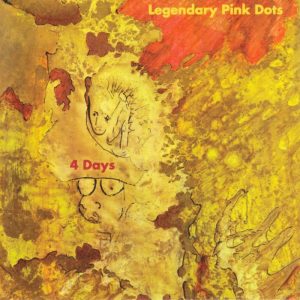
‘Four Days’ EP cover

Four Days (1990)

Tom: You know what? The opener ‘The Day She Left’ suggests this will be the sort of ambient record that would soothe and ease you to sleep if, like me, you’d had brain surgery for a subdural haemorrhage. A wistful, searching melancholy is evoked by fuzzy ambient synths. There’s an unresolved stasis. There are hints of later 1990s drone operatives Stars of the Lid and ambient techno meister Mark Van Hoen. There are even hints of Angelo Badalamenti’s VERY 1990 music for Twin Peaks.

We move from this cousin to Badalamenti’s reveries for Laura Palmer into a piece that decidedly would not make for night-time, getting-to-sleep listening: ‘The Day She Returned’. I found Brian Eno’s Discreet Music (1975) great for this purpose. This would have stalled my recovering sleep patterns like a juggernaut ridden by Brian Blessed. We have gurgling arpeggios that almost sound like a Dalek’s “EXTERMINATE!” and brisk, demented percussive vocals from EK-S. These disintegrate into cacophonic nonsense syllables, all clarity smeared and breaking down. This “speaking in tongues” creates a disconcerting, restless quality. The ending dissolves in a pitch-shifted state of sated collapse.

Wikimedia Commons (dead duck in acidic pond)

‘The Day She Thought About Leaving and Fell into the Duck Pond’ is led by bare and basic early-90s keyboard. It has the sort of vaguely ominous, circling patterns you’d expect in a horror film soundtrack. Halfway in, there is organ and pitch-shifted vocals. There’s a distinctly Nurse With Wound style to the soundscapes here, with sounds jumping out at you like a horror film scream and what is maybe a human pretending to be a cow! Like ‘Premonition 18’, though, this isn’t really as purposeful as peak NWW.

‘Nadelstadt’ has a looming, martial feel, with use of yet another glum arpeggio to underscore the track. This taut piece builds towards an explosion that never quite happens. This is again film soundtrack type music, with the emphasis on suspense.

‘The Day She Lost the Key’ has the sound of a key being dropped repeatedly, alongside weary, nervous human breaths. The continual nature of the dropping suggests this is the interior of her mind we are hearing, exaggerating the enigmatic loss.

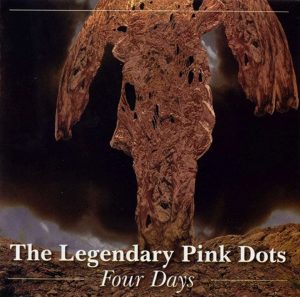
‘Four Days’ Zdzisław Beksiński re-design

‘Excerpt from the Citadel’ moves back to the more serene mood of track #1, but has a stentorian organ as its commanding lead. A thudding beat emerges around the minute mark, joining the spacey synth swishes and squiggles. It could be sound-tracking the arrival of a spaceship, or the rearing into view of a gigantic squid god. This is soundtrack music closer to the Popol Vuh model than the somewhat underwhelming previous few tracks on this album.

Then, we are faced by the indisputable highlight: ‘Divine Resignation Part 1’, which takes a long time to emerge, but gradually unfurls as a lengthier, more brooding variant to the verdant ‘Prav Naaizh’. This has the vast, mythic quality of the Aguirre: Wrath of God (1972) soundtrack but not that film’s subject matter of epochal, heinous imperialism. This track is concerned with a bewildered and unstable god figure’s melodramatic resignation, from the assumed ‘job’ of presiding over what it has created. This gargantuan track earns its thirteen and a half minutes, building inexorably towards Ka-Spel’s monologue as God, which begins around the 10-minute mark. He speaks of creating “a monster”, “that was never the intention. / The bureaucracy of my vision has now made it impossible to realize the totality of the vision itself.”

Follow the god’s restatement of his retirement, we have the musical masterstroke. A crystalline synth riff appears, and it could be Jean Michel Jarre, Vangelis or even Kraftwerk. It’s startling and beauteous. It’s like a blazing, celestial version of the ‘Tour de France’ or ‘Chariots of Fire’, drumming home the point that this god is leaving his own – vastly convoluted – sporting contest, or rat race…

‘Divine Resignation Part 2’ sounds like Big Ben’s chiming in perpetual stasis, the tolling disallowed. This is a very brief fragment, and then we’re into ‘Your Chinese Has Improved’. Again, arpeggios carry the day. There are hints of Yellow Magic Orchestra in the orientalist chord patterns. Later on, a clattering sample enters and is fed into the track as a looped oddity. It’s difficult to make out exactly what it is: presumably some obscure found sound.

View of Pudong from the Bund at night with Shanghai International Conference Center and Oriental Pearl Tower – Shanghai, 15.11.2014

‘East of Shanghai’ is a bit of an inconsequential use of three minutes. Woozy, drawn out chords, with a static lack of progression. It leaves me with the feeling this album would’ve been better as an EP consisting of tracks #1, #2, #6 and #7. Still, those tracks are so good that Four Days is thoroughly worth checking out. Just don’t consider it as a soothing bedtime selection!

AdamFour Days was conceived as a present for a fan. As such it carries the aura of something overheard; a pressed flower furtively passed between teenage lovers in a schoolroom. It is as slight as a whisper, but not less insidious or potentially damaging. As Tom notes, this is not one to be listened to in a precarious mental state.

Unusually for this period of the Dots’ output it is also an album very short on lyrics. Indeed, musically it recalls the soundscapes of Ka-Spel’s solo work or rather more recent Dots albums from the 2010s like much of The Creature that Tasted Sound (2012) or 2013’s Code Noir. Indeed, the fact that 2015 saw the release of an EP entitled Five Days suggests that Four Days is an album that Knight and Ka-Spel have returned to of late.

Because of the drifting, sometimes free-form nature of the album’s music and lack of lyrics, as listeners we (or at least, I) desire to seize hold of anything concrete that might provide some guidance in how to make sense of what is a strange and disquieting, albeit not altogether unpleasant, experience. The fact that several of the tracks’ titles refer to an unknown She – such as ‘The Day She Left’; ‘The Day She Returned’; ‘The Day she thoughts about leaving but fell into the Duckpond’ – cues this anxious-eager listener to attempt to weave the music around an imagined narrative about an indecisive and accident-prone anonymous woman.

However, the only narrative previously known to me that whatsoever seems to fit the template suggested by these song titles is that of Chris Morris’ 2002 short film My Wrongs #8245–8249 & 117, in which an unnamed man, believing his friend’s dog to be talking to him, ends up slipping the dog’s lead noose-like around his neck and getting pulled into a duck pond. The film’s melancholy synthesis of the whimsical and the darkly absurd is a clear match for the tone of Four Days, which – while not as oppressively dark as The Tower (1984) or Island of Jewels (1986) – is permeated by a sense of paranoiac unease.

As the sweet somnambulistic and undulating drones of ‘The Day She Left’ are subsumed by the pneumatic rattle ‘n’ hum of ‘The Day She Returned’ you can imagine our ill-defined protagonist moving from a lightened courtyard downwards into a dark slowly-narrowing corridor as Ka-Spel pursues Pale Man-like jabbering “I’ll slice up my brother! Gonna slice up my brother!” and “I’m a hole in a fence! I’m a hole in a fence!” and other inexplicable threats which morph into incomprehensible vocal sounds repeated compulsively as the music churns on.

© Reon Argondian, ‘The Watchhouse at the End of the World’

‘TDstalbfitDp’ (an equally incomprehensible consonant-heavy noise when rendered as an acronym!) sounds like it uses those presets you used to find on old Yamahas with names like “crystal spheres”, “elvish fantasy” or “icicle palace” in an over-layered miasma of repeated keyboard melodies… to highly effective ends! Not for the first time in the Legendary Pink Dots Project have I been reminded of the sublime papiermâché rococo of the Magical Cavern of self-styled Renaissance artist Reon Argondian embedded in the verdant flank of Petřín Hill in Prague, or of the wonderful subterranean sparkle of fairylight displays in guided cavern tours. That is, until about two thirds into the song at which point the elusive “She” presumably falls into the eponymous duck pond, judging by the fluttery in-takes of breath and ominous sounds of synthesised wind which ensue. The fairylights continue to tinkle.

The nightmarish churning and clanking soundscape of ‘Nadelstadt’ was reimagined in marginally more subtle form for ‘Hellowe’en’ on the wondrous gothic dirge of Crushed Velvet Apocalypse released the same year in 1990 (thus our next to be reviewed). ‘The Day She Lost the Key’ is similarly free from melody… or harmony… or rhythm… instead, we have volume, tone and texture ripped free from any conventional songwriting structures. A tone poem, of sorts. It’s at once creepy and a little self-regardingly so. Sharp in-takes of breath and the sound of a set of keys repeatedly picked up and dropped on metal can be heard. It reminds me a little of the background music that used to play in the 1990s horror-themed video boardgames of the Atmosfear series (“Yes, Gatekeeper!”)

According to the Dots’ bandcamp page, “The story of The Citadel was around for some years in EK’s notebook, and was intended to be the theme for an entire album.” This album has never materialised, but a full track of the same name appears on 1995’s
From Here You’ll Watch the World Go By. Here we are just given what the track-listing refers to as “an excerpt”. It’s a squelchy and doom-laden piece of gothic electronica, markedly heavier than most of the rest of the album. Atmospheric but headache-inducing (or maybe that is just testimony to the fact that we are now half-a-decade  into this project and neither Tom nor myself are getting any younger!)

I’m somewhat less struck by the ‘Divine Resignation’ tracks than Tom. I will note that this is not the first time than Ka-Spel has penned lyrics from the point of view of a deity with an ambivalent relationship towards His creation. While 1985’s Asylum‘s ‘A Message from Our Sponsor’ was couched in a title suggestive of the Dots’ own musical management, it was very clearly from the point of view of a stubbornly non-internationalist God. The deity of ‘Divine Resignation’ by contrast is a self-pitying God, throwing up His hands at a creation that hasn’t turned out quite as He expected. This has an intriguing parallel in a lesser-known track by The Residents – ‘Godsong’, from 1977’s Fingerprince.

Firstly, some lyrics from ‘Divine Resignation Part 1’:

I’ve created a monster, that was never the intention. The bureaucracy of my vision has now made it impossible to realize the totality of the vision itself. Merely a few friends, as equals. No delusions of grandeur. No petty narrow-minded struggles for power.

And from ‘Godsong’:

A major mistake came when God decided that man should think
(A trait that He’d long desired for Himself)
What God no doubt intended was
For man to think about Him
And that was important because
God just wanted to be
Just another normal deity

Personally the lyrics to ‘Godsong’ succeed where those to ‘Divine Resignation’ don’t because the Residents don’t attempt to anthropomorphise God. Rather, He remains disturbingly mindless… almost infant-like in His need for love and attention. I find the concept of Lovecraft/Ligotti’s “blind idiot God”, despite its squicky ableist connotations, far more convincing that the concept of a bureaucratic God. Bureaucracy firmly belongs to the futile world of humans.

Lastly, ‘Your Chinese Has Improved’ sounds exactly like how the music for an early 90s videogame set in Ancient China should sound. A thousand porcelain bowls in pixel form. ‘East of Shanghai’ must be inspired by the 1931 Hitchcock film also known as Rich and Strange. It beckons like a lighthouse from the fog. Very short and quite evocative. East of Shanghai isn’t regarded as essential Hitchcock and this isn’t really essential Dots.

Overall however Four Days is a rich and lucid trip offered as a gift. It does not feel like a Work of Great Substance but I suspect it was not intended to be. It is a nice eerie way to while away an hour. Lightly but warmly recommended.

Written by

May 12, 2018

source: http://kittysneezes.com/2018/05/12/four-days/