


 The Legendary Pink Dots’ discography is so expansive that it’s difficult to say something about their music with full authority. The Dots’ founding members—Edward Ka-Spel and Phil Knight—may not even know for themselves how many albums they have released by this point, although it’s safe to say the number of studio records exceeds 40. In 2014 alone, the band released one LP—10 to the Power of 9—two live albums and two compilations. One of those compilations, 12 Steps Off the Path, appeared in my inbox to review. Although there’s no knowing why 12 Steps Off the Path arose as the victor among the Legendary Pink Dots’ 2014 output, it does highlight the things that can be said about the band’s music—namely, it’s dark and filled with esoteric mystique, it’s loud, it’s psychedelic, it’s synthy, it’s gothy, and it’s still more thrilling today than many of the most hotly praised albums of the year.
12 Steps Off the Path was compiled and released in an effort to restore some of the Dots’ back catalogue that has, for one reason or another, disappeared over the years. As with many Legendary Pink Dots compilations, it proves that even the band’s rarities are better than studio releases from a number of bands that acquire similar themes and sounds and run mindlessly with them. Ka-Spel’s lyrics can be hard to grasp for the layman, but the overall feel of the music is forever giving a sense of looking under the carpet of this surface world and uncovering some ancient evil. Even a sing-songy number like “A Moustache on the Mona Lisa and Other Things You May Find in the Trash” has almost the same vaudeville-gone-nightmare feel as the “Singin’ in the Rain” scene in A Clockwork Orange.
Other songs raise the drama in unexpected ways. “Citadel”, originally appearing on 1995’s From Here You’ll Watch the World Go By and one of a number of live songs on this compilation, starts with a meandering synth line and easy brass. It is not long, though, until Ka-Spel’s vocals blast off from his standard pitch and run rampant through the second half of the song, erupting at song’s end in a ferocious “Come to Daddy daddy daddy” while the horns take a similarly chaotic turn.
If you haven’t already guessed, the Legendary Pink Dots’ music certainly doesn’t make for easy listening. Selections like “A Japanese Manual for a Broken Wheel” are customarily noisy. Quieter moments like “Goldilocks” will employ suspenseful pulses and throbs that work to cushion Ka Spel’s terrifying missives. “I confess I’ve never had a hobby / Except you / And me” has never sounded so threatening. Yet, there are also moments on 12 Steps Off the Path that showcase the beauty behind the Dots’ music, such as the almost tranquil Eastern-tinged closer “Out There Part 2”.
Seeing as press on the Legendary Pink Dots, in this day and age, is comparatively minimal to their output, it can be troubling to think of their music—compilation or not—lost among the clutter and clatter of Bandcamp and other online music distribution sites. Even one critic telling one curious music listener that something—anything—in the Legendary Pink Dots’ discography is worth their time is the most minuscule drop in a gigantic, ever-changing pond, but then again, enlightenment isn’t the easiest thing to find. Ultimately, there is actually too much to say about the Legendary Pink Dots, but most of it is still worth hearing out.
source: http://bit.ly/1G8l0MA
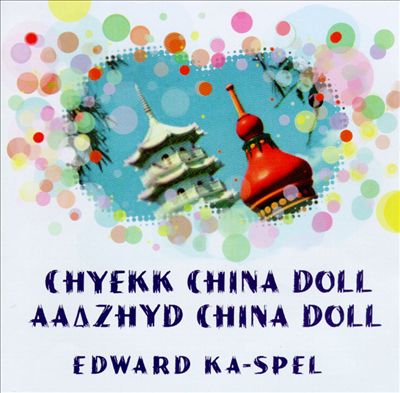 With the help of Nurse With Wound mainman Steven Stapleton on “tapes, piano, and inspiration,” Ka-Spel collaborated with multi-instrumentalist Patrick Wright on Chyekk China Doll, a worthy entry in Ka-Spel’s lengthy, involved series of solo works. As with most of his solo work, the artist moves sideways from the collapsing, queasy anarchy of the Legendary Pink Dots for a quieter but no less freaky combination. Wright plays a core role throughout, cowriting nearly all the songs and adding his haunting, heavily echoed violin work to many songs, further rendering the playfully cartoon music-in-hell compositions even more curious. The aura of fragile chamber music and oddly elegant ballroom dancing on the brief “Chyekk 1” and “Chyekk 2” and the downright captivating start to “The Glory, the Glory” are some of his standout moments. “Lisa’s Christening,” meanwhile, really does sound like a religious ceremony of some sort, though not exactly one which might be called a traditional Christian rite. Stapleton’s ear for jarring, sudden cuts and random samples further spikes the brew at points — check the brief “Klazh, Tristurr” or the echoing rumble of “The Power, the Power” for a headspinning listen — all making a just disorienting enough combination for Ka-Spel to play in. Sometimes he submerges his vocals in the mix, but, at points, as on the very appropriately titled “The Infinity Waltz,” it goes front and center, his gently declamatory style suiting the results. Ka-Spel’s wiggy sense of humor helps in some of the arrangements as well — who else would whip up a jazzy, ’20s-style strut like “Beautiful Naked” while still making it sound like an invocation to the beyond? Later versions included two tracks recorded in 1994 by Ka-Spel without Stapleton or Wright; the winner of the two is “Colour Me Vexed, Desiree,” an unnerving, lengthy swirl of keyboards, feedback, and heavily treated vocal snippets.
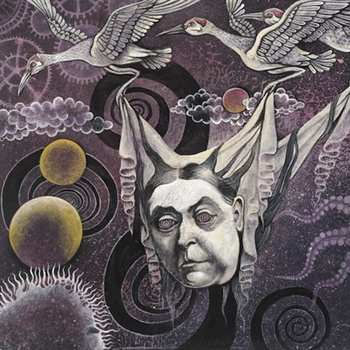 If Syd Barrett were an 80s Goth he would be Edward Ka-Spel of the Legendary Pink Dots. At first the album did not strike me as anything great, but after several spins the album both nods toward the 25 year old Legendary Pink Dots classic LP The Maria Dimension (which is getting a 5LP box treatment from the Soleilmoon label very soon) and 80s Edward Ka-Spel albums like his China Doll series of LPs from the 80s. The vocals are cryptic and dark and gothic, a strange piano, odd finger drums and the intro to the first song called Limburgia has a Indian raga like beat. All the 8 tracks flow like a single sequence of interworked songs, though they are all different and separate tracks. Here we do not have the Noise sculpture and abstract Industrial splatter like on Dream Loops or Ghost Logik from a few years ago, nor the electronic madness of Edward’s Dream Logik trilogy. The third track, The Border Beyond, has ominous police sirens in the distance closing in and leaving again, fading in and out again like a spectre on the “force”. Edward sings very low key. It takes either great concentration to follow his lyrics, or you can do like me, imagine the darkwave ramblings of a 80s Goth Syd Barrett, though as a lyricist Edward and Syd do not share any similarity, just the voice and the beatnik whimsy style. I ordered the double disc Deluxe set and got a second CD with two tracks, one song is etched as vinyl on the CDR and plays perfectly on my turntable while the other song is there next to it as a digital track, and they both share the same side of the disc. Those two tracks are very analogue and Victorian style forms of musics, maybe after a little Opium and Absinthe…